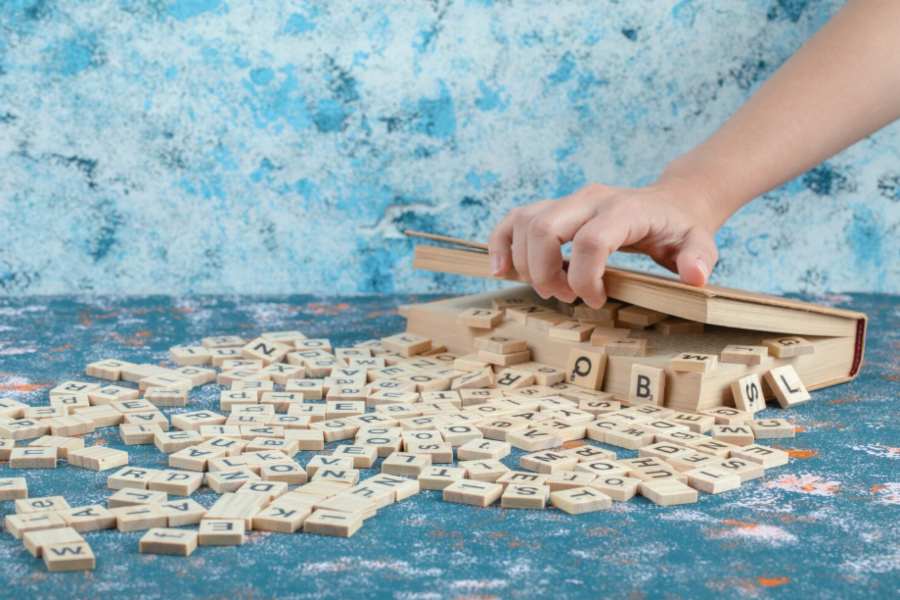
If you've ever spent twenty minutes staring at a Wordle grid or rearranged letters in Wordscapes until your eyes crossed, you already know that word puzzles are more than just a way to kill time. What you might not realize is that the mental habits you're building while playing these games are quietly shaping the way you write.
Vocabulary, pattern recognition, conciseness, and an instinct for how words fit together — these are the building blocks of good writing, and they happen to be exactly what word puzzles train. When you hit a wall trying to express an idea clearly, tools like a paraphrasing tool can help you see the same thought from a different angle — much like shuffling letters in a puzzle to spot combinations you'd missed. Whether you're a student, a professional, a blogger, or someone who just loves a good crossword before bed, the strategies you use to win at word games can make you a noticeably better writer. Here's how.
1. Starting with Short Words Trains You to Be Concise
One of the first strategies any Wordscapes or Wordle player learns is to start with short, simple words. Three and four-letter combinations are easier to spot, help you eliminate possibilities faster, and often unlock longer words hiding in plain sight.
This same principle applies directly to writing. One of the most common mistakes writers make — at every level — is using long, complicated words when shorter ones would do the job better. "Utilize" instead of "use." "Demonstrate" instead of "show." "In the event that" instead of "if."
Word puzzle players develop an almost reflexive appreciation for the power of short words. When you spend hours trying to squeeze meaning out of five or six letters, you start to understand that short words carry enormous weight. That instinct translates directly onto the page. The best writers in the world — from Hemingway to George Orwell — have always championed simple, direct language, and word puzzles quietly train you to think the same way.
Writing takeaway: Next time you're editing a piece of writing, challenge yourself to replace every long word with a shorter one wherever possible. You'll almost always find the shorter version is cleaner and more powerful.
2. Hunting for Bonus Words Builds a Richer Vocabulary
In Wordscapes, bonus words are valid words that don't fit the crossword grid but are still recognized by the game's dictionary. Hunting for them pushes you beyond the obvious combinations and forces you to explore less common vocabulary — words you might never have thought to use in everyday language.
This habit of actively reaching for less familiar words is invaluable in writing. A rich vocabulary doesn't just make your writing sound more impressive — it gives you precision. The difference between "happy," "elated," "content," and "gleeful" isn't just stylistic; each word carries a subtly different meaning. Writers with a broad vocabulary choose the exact right word for the exact right moment.
The bonus word mentality, always looking for one more option, one more possibility — is the same mindset that makes writers search for a better verb, a more specific noun, or a fresher adjective instead of defaulting to the first word that comes to mind.
Writing takeaway: Keep a running list of new words you discover while playing word games. Look them up, understand their nuances, and consciously try to use them in your next piece of writing.
3. Pattern Recognition Improves Sentence Structure
Experienced word puzzle players don't just see individual letters — they see patterns. Common prefixes like "un-", "re-", and "pre-". Familiar suffixes like "-ing," "-tion," and "-ed." Letter pairs that almost always appear together. Over time, this pattern recognition becomes automatic.
In writing, sentence structure works the same way. Strong writers develop an instinct for how sentences should be built — where to place the main idea, how to vary sentence length for rhythm, when a short punchy sentence hits harder than a long flowing one. These aren't rules you memorize; they're patterns you internalize through practice.
Word puzzles accelerate this process because they force your brain to work with language structurally rather than just semantically. You're not just thinking about what words mean — you're thinking about how they're built, which is exactly the mental shift that separates average writers from great ones.
Writing takeaway: After finishing a draft, read it aloud and pay attention to the rhythm. Short sentences followed by longer ones, just like short words followed by longer combinations in a puzzle, create natural flow and keep readers engaged.
4. Playing Under Constraints Teaches Editing Discipline
Every word puzzle operates under strict constraints. You have a fixed set of letters. The word must fit a specific number of spaces. There are no exceptions. This forces you to make the best possible choice within a defined boundary — which is exactly what editing requires.
Good writing is really just good editing. The first draft is the puzzle board with all the letters scattered; the edited version is the completed grid. Puzzle players are naturally comfortable with constraints because the game is built around them. That comfort carries over into writing — the willingness to cut a sentence you love because it doesn't fit, to replace a word you prefer because a better one exists, to trim a paragraph that wanders off-topic even if it took effort to write.
Writers who play word games regularly tend to be less precious about their work, more willing to rearrange and rethink, and faster at recognizing when something isn't working. These are exactly the qualities that separate writers who improve quickly from those who stay stuck.
Writing takeaway: Set yourself a word limit on your next piece of writing, tighter than you think you need. Then work within it. The constraint will force you to prioritize every word, just like a puzzle forces you to make every letter count.
5. The Shuffle Mentality Teaches You to Rethink, Not Just Rewrite
One of the most underrated features in word puzzle games is the shuffle button. When you're stuck and can't see any new combinations, shuffling rearranges everything and suddenly a word you'd missed becomes obvious. It's not that the answer changed — your perspective did.
This is one of the most transferable skills from puzzle play to writing. When a paragraph isn't working, most writers try to fix it by tweaking words here and there. But sometimes what the paragraph needs isn't a tweak — it needs a complete restructure. Moving the conclusion to the opening, breaking one long sentence into three short ones, or flipping the order of two ideas entirely.
The shuffle mentality gives writers permission to completely rethink a passage rather than just patching it. It's a more creative and often more effective approach to revision, and it's a habit that word puzzle players build naturally over time.
Writing takeaway: When a section of your writing feels stuck, don't just edit it — shuffle it. Move sentences around, try a completely different opening, or restructure the argument from scratch. The answer was always there; sometimes you just need a new angle to see it.
Final Thoughts
Word puzzles and writing might seem like separate pursuits, but they share the same core skill: making language work as hard as possible with whatever you have available. The strategies that make you better at Wordle, Wordscapes, or any word game — conciseness, vocabulary breadth, pattern recognition, editing discipline, and the willingness to rethink rather than just rewrite — are the same strategies that make you a stronger, cleaner, and more expressive writer.
So the next time someone tells you you're wasting time on a word game, tell them you're working on your craft. Because in a very real sense, you are.