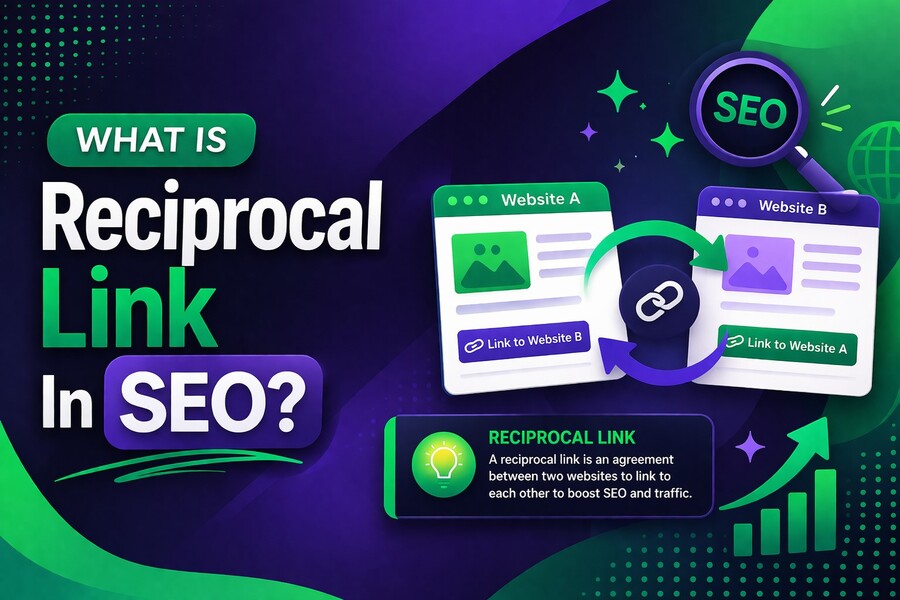
If you are trying to understand what is reciprocal link in SEO, you are asking an important question that can shape how you build authority, trust, and long-term rankings.
A reciprocal link occurs when one website links to another, and that second website links back. The SEO impact depends on why the links exist, how relevant they are, and whether they help real readers.
This guide explains how reciprocal links work, when they can support your site, when they can trigger risk, and how you can use them without falling into low-quality link-building habits.
What Reciprocal Link Means In SEO
A reciprocal link in SEO is a two-way link relationship between two websites, where each site links to the other within relevant content or resource pages. This idea sounds simple, but the real issue is not the exchange itself, because search engines care more about whether the link exists to help users or to manipulate rankings. Search engines do not treat every two-way link as spam, but they do pay attention when link exchanges appear excessive, repetitive, or disconnected from the topic.
You should think of reciprocal links as a normal part of the web when they happen naturally between related businesses, publishers, or educational resources. For example, one site may cite a useful guide, and the other site may later reference a related article because the topics genuinely overlap and serve the same audience. Even outside SEO, recognizing patterns becomes easier when you test and improve your word puzzle skills with custom wordle and learn how structure, sequence, and relationships affect the final result.
How Reciprocal Links Work In Practice
Reciprocal links usually happen in one of two ways, and the difference between them matters a great deal for SEO. The first is natural reciprocity, where two strong pages independently reference each other because both pieces add context, clarity, or supporting information for readers. The second is arranged reciprocity, where site owners agree to swap links directly, and that is where risk starts to rise if the exchange is scaled, repeated, or poorly matched.
In practice, a safe reciprocal link often appears within editorial content that already deserves a citation, not on a random page created solely to trade backlinks. That is why structure matters, because a strong linking decision often depends on combinations, sequence, and timing, much like how many words can you make with these letters game rewards careful thinking instead of random guessing. When your link choices follow topic relevance, reader intent, and page quality, the relationship looks natural rather than manufactured.
Are Reciprocal Links Good Or Bad For SEO
Reciprocal links are neither automatically good nor automatically bad, which is why this topic confuses so many site owners. Relevant, moderate reciprocal links can support user experience, referral traffic, and niche relationships, especially when the pages involved are useful and trustworthy. The problem begins when too many of your backlinks come from obvious swaps, because that creates a footprint search engines can interpret as manipulation rather than editorial value.
The better question is whether the link helps the reader complete a task, answer a question, or understand the topic more clearly. On the web, useful connections often depend on how well separate pieces fit together, and that same idea appears in what is it called when you scramble a word to make another, where meaning changes once letters are rearranged with purpose. SEO works similarly: not every two-way link is harmful, but every link should fit the page, the audience, and the surrounding context.
When Reciprocal Links Can Help Your Website
Reciprocal links can help your website when they connect two pieces of content that genuinely belong together and improve the user journey. If you run a niche blog, a law resource, a local business site, or a SaaS knowledge base, a carefully placed two-way link can send qualified traffic, reinforce topical relevance, and make your content ecosystem more useful. When the pages speak to the same audience and solve related problems, the link relationship can feel practical instead of manipulative.
Signs Of A Helpful Reciprocal Link
A helpful reciprocal link usually sits inside a paragraph where the linked page naturally extends the point you are making, not in a forced list of unrelated websites. It points readers toward complementary information, uses descriptive anchor text, and comes from a page that already has substance, authority, and clear purpose. When those conditions are present, the link feels less like an SEO tactic and more like a logical editorial decision that helps readers move forward.
When Reciprocal Links Become Risky
Reciprocal links become risky when you stop thinking like a publisher and start thinking only like a shortcut seeker. If you exchange links at scale, create partner pages only for cross-linking, or accept links from irrelevant and low-quality sites, you make the pattern easier for search engines to distrust. Excessive exchanges that exist mainly to influence rankings can weaken your credibility and attract the wrong kind of attention.
The danger also increases when your anchor text looks repetitive, your partner sites sit outside your niche, or the links appear in sitewide locations with little editorial context. Those patterns weaken credibility because they signal to search engines a relationship built around backlinks first, with usefulness second. If your linking profile starts to look engineered, the short-term gain can easily turn into a long-term loss in trust, visibility, and organic stability.
How Google Views Reciprocal Linking
Google does not ban every reciprocal link, and that distinction matters if you want a realistic SEO strategy. The web naturally produces two-way links when people cite each other’s work, reference related tools, or publish content that overlaps in a helpful way. What Google opposes is excessive link exchange or link schemes designed mainly to manipulate rankings rather than serve users.
Natural Reciprocity Vs Link Schemes
Natural reciprocity happens when two useful pages earn references because they belong in the same conversation, and readers benefit from the connection. A link scheme occurs when websites enter into link-swapping arrangements as a ranking tactic, often with little regard for quality, relevance, or the visitor’s next step. That is why the safest approach is not to chase reciprocal links as a primary strategy, but to publish pages worth citing so that any two-way links that emerge look earned and defensible.
Best Practices For Using Reciprocal Links Safely
If you decide to use reciprocal links, moderation should guide every decision you make. Choose relevant sites, link only where the destination improves the page, vary your anchor text naturally, and avoid building a backlink profile that leans too heavily on exchanges. You should also monitor those links over time so you can remove outdated, low-quality, or no-longer-relevant references before they hurt user experience.
You should also review the quality of the page that will link back to you, because not every backlink is worth having. A strong reciprocal link comes from a page with clear purpose, real content, topical fit, and reasonable trust signals, while a weak one often comes from a thin article, an irrelevant resource list, or a site that exists mainly to trade links. Safe SEO usually looks boring from the outside, but that discipline is what protects your rankings over time.
Common Mistakes Website Owners Make
One common mistake is assuming that any backlink is good as long as it points to your site. That belief leads people into random exchanges with unrelated websites, bloated footer links, or entire partner pages built only to collect outbound links with little editorial value. Search engines and experienced readers can quickly recognize that pattern, and once they do, the page's credibility starts to drop.
Another mistake is ignoring proportion and context inside your broader link profile. If too many of your backlinks are reciprocal, or if the same few websites keep linking back and forth across multiple pages, the pattern can look staged even if each individual link seems harmless. The smarter approach is to keep your backlink mix diverse, earn one-way editorial mentions whenever possible, and treat reciprocal links as a limited supporting tactic rather than a growth engine.
How To Audit Reciprocal Links On Your Site
You should audit reciprocal links the same way you would review any other SEO asset, because link quality changes over time. Start by identifying which sites link to you and whether you also link back to them, then evaluate topic relevance, page quality, anchor text, and the actual usefulness of the connection to readers. Routine auditing becomes more important as your site grows, because older link relationships can quietly become outdated or irrelevant.
During the audit, ask a simple question about each two-way link: Would you keep this connection if Google did not count links as a ranking signal at all. If the answer is yes, because the linked page helps your audience and strengthens the article, the link may be worth keeping. If the answer is no, because the page feels forced, thin, or irrelevant, that is your signal to remove it, replace it, or stop building similar links in the future.
Conclusion
What is reciprocal link in SEO really comes down to intent, relevance, and restraint. A reciprocal link can be perfectly reasonable when two strong pages reference each other to help readers, but the same tactic becomes dangerous when it turns into a large-scale exchange pattern built for rankings rather than usefulness. If you focus on high-quality content, selective partnerships, natural anchor text, and routine audits, you can keep the benefits of topical connection without inviting the risks that come with manipulative link-building.