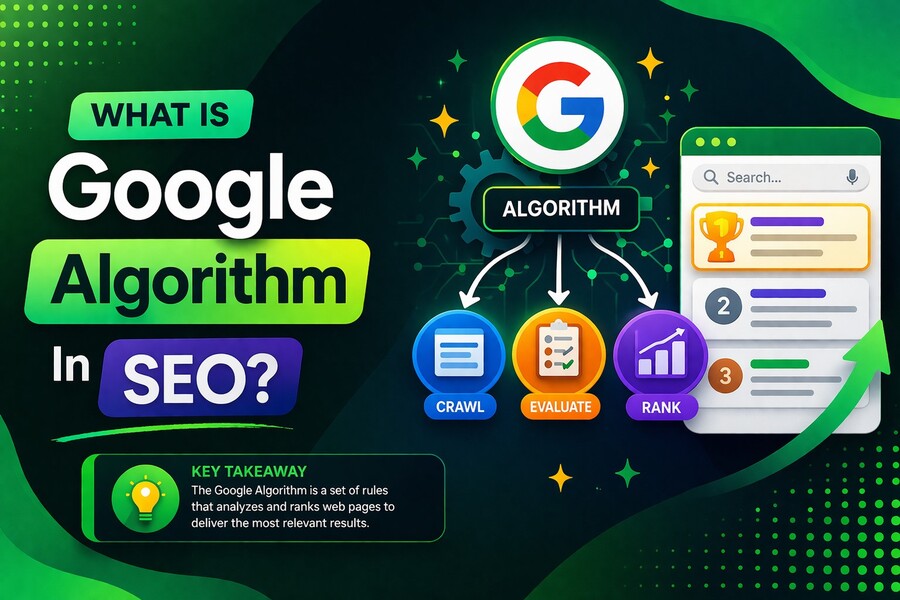
When you ask, “What Is Google Algorithm In SEO,” you are really asking how Google decides which pages deserve attention and which ones do not. That question matters because the algorithm shapes your visibility, your traffic, and your ability to compete in search when users need answers, products, or services. If you understand the logic behind the system, you can build pages that satisfy real intent instead of chasing outdated tricks.
This guide gives you a practical explanation of how the algorithm works, why it changes, and what you should do if you want stronger rankings in a crowded market. You will also see which signals still matter, which habits can hurt you, and how to create content that fits the direction Google has taken over the last several years.
What Google Algorithm Means In SEO
Google’s algorithm is the system Google uses to retrieve, interpret, and rank pages in search results. In plain terms, it reviews enormous numbers of pages, looks for signals tied to relevance and quality, and then decides which pages best answer a searcher’s query.
That system is not a single fixed formula that stays the same forever. It is a changing collection of rules, models, and ranking systems that help Google understand topics, judge usefulness, and sort results in an order that feels most helpful to the user.
If you want a simple way to picture it, think of SEO as structured problem-solving where each page must prove its value. That same pattern-based thinking is why many people test your word puzzle skills with Custom Wordle when they want a fast way to sharpen recognition, deduction, and precision under clear rules.
How Google Decides Which Pages Rank First
Google starts by crawling and indexing pages, but ranking begins when someone performs a search. At that moment, Google tries to understand the wording, intent, and context of the query, then compares that need against the pages in its index.
The algorithm evaluates many signals rather than relying on one factor alone. WebFX notes visible signals such as keyword use in titles, headers, and meta descriptions, along with organic links and mobile performance, while newer explanations also stress usefulness, technical quality, and user satisfaction.
You can think of this process as matching patterns at scale instead of counting keywords in isolation. That is one reason pages about how to play wordscapes resonate with people who enjoy structured word challenges, because they show how meaning, letter order, and grid constraints work together rather than separately.
Why Google Algorithm Updates Changed SEO So Much
Early SEO often rewarded tactics that were too easy to manipulate, which led Google to improve its systems over time. Major updates such as Panda and Penguin pushed the industry away from thin content, duplicate pages, and spammy link building by making quality and trust much more important.
Then Google became better at understanding language, meaning, and ambiguity. Hummingbird improved natural language processing, RankBrain brought machine learning into query interpretation, and BERT helped Google understand words in context instead of treating every search like a loose bag of keywords.
More recently, Google has continued to reward content written for people instead of search engines. Verkeer notes that the Helpful Content system was folded into the core ranking approach in 2024, reinforcing the broader shift toward genuine usefulness, strong technical performance, and clearer alignment with user needs.
The Ranking Signals That Matter Most Today
If you want a useful answer to “What Is Google Algorithm In SEO,” focus less on secrets and more on consistent signals. The clearest patterns across the reviewed sources are relevance, originality, backlink quality, mobile usability, technical performance, and content that satisfies the searcher instead of merely repeating the keyword.
Google also appears to reward experience, expertise, authoritativeness, and trustworthiness, often shortened to E-E-A-T. That does not mean a magic score appears on your page, but it does mean your writing, sourcing, structure, and credibility all affect how competitive your content feels in search.
A practical way to remember this is to view ranking like a series of logic checks instead of one grand shortcut. Writers who like systems thinking often benefit from reading about what are the different types of puzzles, because different puzzle formats train recognition, sequence analysis, and solution discipline that mirror strong SEO decision-making.
Search Intent Is The Real Core Of Modern SEO
A page can be well-written and still fail if it misses intent. Google has become much better at interpreting whether the user wants a definition, a comparison, a product, a local result, or a step-by-step guide, which is why intent matching now sits at the center of modern SEO strategy.
This change is one reason keyword stuffing lost power. Verkeer explains that today’s algorithm focuses on meaning and intent far more than mechanical repetition, while Tech Tales highlights relevance and value-addition over clickbait as a better path to stable rankings.
For you, that means every page should answer one dominant question clearly and completely. If your target keyword is informational, lead with definitions, examples, and usable advice, but if it is transactional, make the page easier to scan, compare, and act on without friction.
What Can Hurt Your Rankings Fast
The fastest way to lose ground in search is to build pages for algorithms instead of people. The sources consistently warn against keyword stuffing, hidden text, manipulative linking, duplicate content, thin pages, and other black-hat methods that try to manufacture relevance instead of earning it.
Low-quality automation can also become a problem when it produces bland, repetitive, or inaccurate pages at scale. If you use AI during content creation, tools like Humanize AI can help refine rough drafts so the final page sounds clearer, more natural, and more useful for readers.
Technical neglect can hurt you too, even when your writing is strong. If your site loads slowly, performs poorly on mobile, confuses users with weak structure, or fails to support trust with clear page quality signals, you reduce the odds that Google will see your content as a strong result.
How You Should Optimize For Google Algorithm In SEO
Start by building pages around real questions, not empty keyword targets. Your headline, introduction, headers, and body copy should work together to answer the query directly, while your examples, formatting, and supporting details should make the page easier for both users and search systems to understand.
Next, strengthen quality signals that help your content compete. That includes writing from experience, improving factual accuracy, tightening structure, making your site mobile-friendly, earning relevant links, and removing weak sections that add bulk without adding value.
You should also review performance over time instead of chasing every rumor about ranking factors. Rankings are fluid, as WebFX explains, so your job is not to outguess Google every week but to publish better pages, refine them when needed, and keep improving the experience users get after the click.
What A Smart SEO Workflow Looks Like In Practice
A smart workflow begins with query selection and intent mapping. Before you write, decide whether the user wants a definition, a list, a tutorial, a product page, or a local service result, then shape the page so its structure reflects that purpose from the first screen onward.
After that, build depth without losing clarity. Use clean headers, concise paragraphs, meaningful examples, and supporting details that remove confusion, because Google increasingly rewards content that is both comprehensive and easy to use rather than bloated for the sake of word count.
Finally, measure outcomes that matter. Watch impressions, clicks, engagement, and conversion behavior together, because strong SEO is not only about ranking first, but about attracting the right visitor and giving that visitor a page worth trusting, reading, and acting on.
Conclusion
So, what is Google Algorithm In SEO? It is the evolving system Google uses to judge relevance, understand intent, and rank pages based on quality, trust, usability, and overall usefulness to the searcher.
If you want stronger long-term results, stop treating SEO like a loophole hunt. Write for people, structure your pages well, support your claims with real expertise, improve your technical foundation, and make every section of every page serve a clear purpose.
That approach aligns with how Google has moved from basic keyword matching toward language understanding, machine learning, and people-first quality systems. When your content solves the right problem in the clearest and most credible way, you give yourself the best chance to earn visibility that lasts.