If you want to sell to other businesses online, you need more than a website and a few ads. You need a system that attracts the right companies, speaks to real business problems, and moves buyers through a longer, more careful decision-making process.
This guide explains what B2B digital marketing is, why it works differently from B2C marketing, which channels matter most, and how you can build a strategy that turns attention into qualified leads and long-term revenue.
What B2B Digital Marketing Means
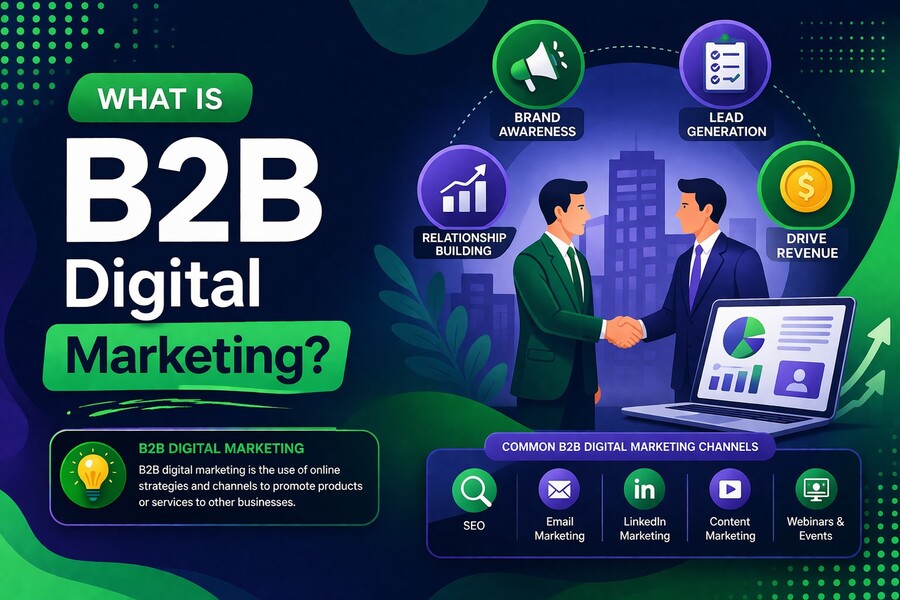
B2B digital marketing is the use of online channels to promote products or services from one business to another business. Instead of targeting individual shoppers, you are speaking to employees, managers, and executives who buy on behalf of their company, which means your message must address business pain points, measurable value, and practical outcomes.
Wrike and WebFX both describe it as a digital approach built around reaching business buyers through channels such as search, email, content, and social media.
This makes B2B marketing more structured than many consumer campaigns because your buyers are usually slower, more informed, and more cautious. In practice, the same habits that help you improve your word puzzle skills with Custom Wordle also reflect a useful marketing mindset, since pattern recognition, steady testing, and smart adjustments improve results over time. When you approach B2B digital marketing that way, you stop guessing and start building a repeatable growth system.
How B2B Digital Marketing Differs from B2C Marketing
The biggest difference between B2B and B2C marketing is not the platform you use, but the way people buy. Universidad Europea explains that B2B purchases involve a more complex decision-making process, longer sales cycles, and stronger emphasis on trust, credibility, and long-term relationships. That means you are not just trying to trigger interest quickly, because you are helping a buyer justify a purchase to colleagues, leadership, or finance teams.
B2B buyers also care deeply about proof, which is why authority signals matter at every stage of the funnel. In many industries, best ways to increase your average customer review rating align with the same trust-building principle, because stronger reviews reduce doubt and make your brand easier to evaluate. If your content, website, and messaging fail to support that evaluation process, you may attract traffic without earning serious business conversations.
Why the B2B buying journey is more complex
In B2B digital marketing, you are often selling to a group rather than to one person. Salesforce explains that the buying committee can include stakeholders from operations, finance, IT, sales, marketing, or facilities, depending on the product, which means each person may judge your offer through a different lens. One person may care about cost, another about security, another about implementation time, and another about revenue impact.
That is why your marketing assets need range, clarity, and visual strength across the entire journey. Creative teams often improve campaign presentation in the same way that how designers can expand their portfolio using an animation maker highlights motion, polish, and user experience as signals of skill. When your case studies, landing pages, demos, and emails look clear and credible, they support the confidence every stakeholder needs before approval happens.
The core channels that drive B2B results
Most successful B2B strategies rely on a small group of channels working together instead of acting alone. Across the sources, the core mix includes SEO, content marketing, email marketing, social media, and paid campaigns, with each one helping you attract attention, educate prospects, and move leads toward sales conversations. SEO helps people find you, content builds authority, email nurtures interest, and paid media accelerates visibility when you need faster reach.
You should think of these channels as connected parts of one engine rather than separate tasks on a checklist. A search visitor may read a useful article, subscribe to your email list, return through a retargeting ad, and finally request a demo after seeing proof that your offer solves a business problem. When those touchpoints match each other in tone, message, and value, your marketing feels reliable instead of fragmented.
Why content is the backbone of B2B digital marketing
Content matters in B2B because business buyers need clarity before they commit money, time, and internal support to a solution. Salesforce describes demand generation as using helpful content to build awareness, while Wrike highlights content marketing as a way to educate and attract the right audience through useful information. That means your content is not decoration, because it is often the first proof that your business understands the buyer’s problem.
Good B2b content answers commercial questions with precision. It can take the form of blog posts, landing pages, email sequences, comparison pages, webinars, white papers, video explainers, and case studies, but each asset should move the reader closer to confident action. If your content does not reduce uncertainty, sharpen decision-making, or connect features to outcomes, it will struggle to produce qualified leads.
SEO and email turn interest into qualified leads
SEO is one of the most dependable B2B channels because it captures prospects at the moment they are actively looking for solutions. Wrike notes that strong SEO includes keyword use, metadata, alt text, and inbound links, while WebFX stresses that digital marketing is measurable, which makes search traffic easier to evaluate and improve over time. If your site ranks for the right commercial and informational terms, you can attract buyers before your competitors enter the conversation.
Email then helps you keep the conversation alive after the first visit. Universidad Europea emphasizes segmentation by role, industry, and stage in the funnel, and Wrike also points to clear subject lines, focused calls to action, and mobile-friendly design as practical factors that improve performance. When you pair SEO with segmented email nurturing, you create a system that keeps your brand visible during long buying cycles.
Demand generation, lead generation, and nurturing
A lot of companies treat all lead activity as one task, but B2B marketing works better when you separate key stages. Salesforce draws a clear line between demand generation, which builds awareness through useful content, and lead generation, which captures interest from people who share their information and show real buying intent. That distinction matters because awareness content and conversion content should not sound the same or ask for the same level of commitment.
Lead nurturing comes next, and that is where many B2B teams either win trust or lose momentum. Once a prospect enters your funnel, your job is to provide the right information at the right time through email, case studies, demos, product pages, and follow-up content that helps shape intent. When marketing and sales align around that process, the handoff feels natural and the buyer experiences a smoother path to purchase.
Personalization, abm, and marketing automation
Personalization is no longer optional in B2B because broad messaging rarely speaks well to complex business needs. Universidad Europea highlights account-based marketing as a strategy that focuses on high-value companies with tailored communication, and Salesforce reinforces that ABM works especially well when multiple leads from one account are part of the same buying committee. This approach improves relevance because you are speaking to a specific company context rather than to a vague market segment.
Automation makes that personalization easier to manage at scale. CRM systems, email workflows, lead scoring, and behavior-based triggers help you deliver timely messages without relying on manual follow-up for every contact. Used well, automation does not make your marketing robotic, because it gives you more room to be consistent, responsive, and useful throughout the buyer journey.
How to measure success and improve performance
One reason B2B digital marketing is so valuable is that it can be measured with much greater precision than many offline tactics. WebFX specifically points out that B2B digital marketing is measurable and can produce strong ROI, which helps you see which channels deserve more budget and which ones need adjustment. Instead of relying on instinct alone, you can review traffic quality, lead volume, conversion rates, pipeline impact, and revenue contribution.
The most useful metrics usually include organic traffic, click-through rate, cost per lead, lead-to-opportunity rate, demo requests, email engagement, and close rate by source. You should also evaluate content by business outcome, not just by pageviews, because a lower-traffic page that attracts qualified buyers may be far more valuable than a popular article with weak conversion intent. When your reporting connects activity to revenue, your strategy becomes easier to defend and refine.
Common mistakes that weaken B2B marketing
Many B2B campaigns underperform because the message is too broad and the strategy is too shallow. If you try to appeal to everyone, ignore the buying committee, or publish content without commercial purpose, you may create visibility without building real pipeline. Business buyers want proof that you understand their problem and can solve it with less risk than the alternatives.
Another common mistake is treating channels as isolated tactics with no shared direction. A company may run ads, publish blogs, send emails, and post on LinkedIn, but still struggle because the messaging is inconsistent, the landing pages are weak, or the follow-up process is unclear. The strongest B2B programs succeed because every asset supports the same goal, the same audience, and the same value proposition from first click to signed contract.
Conclusion
B2B digital marketing is the process of using online channels to attract, educate, and convert business buyers with messaging that supports a longer and more careful purchasing journey. It works best when you understand the buyer’s role, create content that reduces uncertainty, use SEO and email to maintain visibility, and align your marketing with the real steps companies take before they buy. If you focus on trust, relevance, and measurable outcomes, you can turn your marketing from a collection of disconnected tasks into a system that produces qualified leads, stronger relationships, and steady business growth.